06 September 2019

2016 王者歸來 Return of the King


One of the new teas from San Ho Tang tea factory of Xi Zhi Hao brand named after a Lord of the Rings novel - Return of the king.

Ok, I suppose this is not really a LOtR rip-off but more like a reference of a past Cha Wang (Tea King) cake by Xi Zhi Hao. 

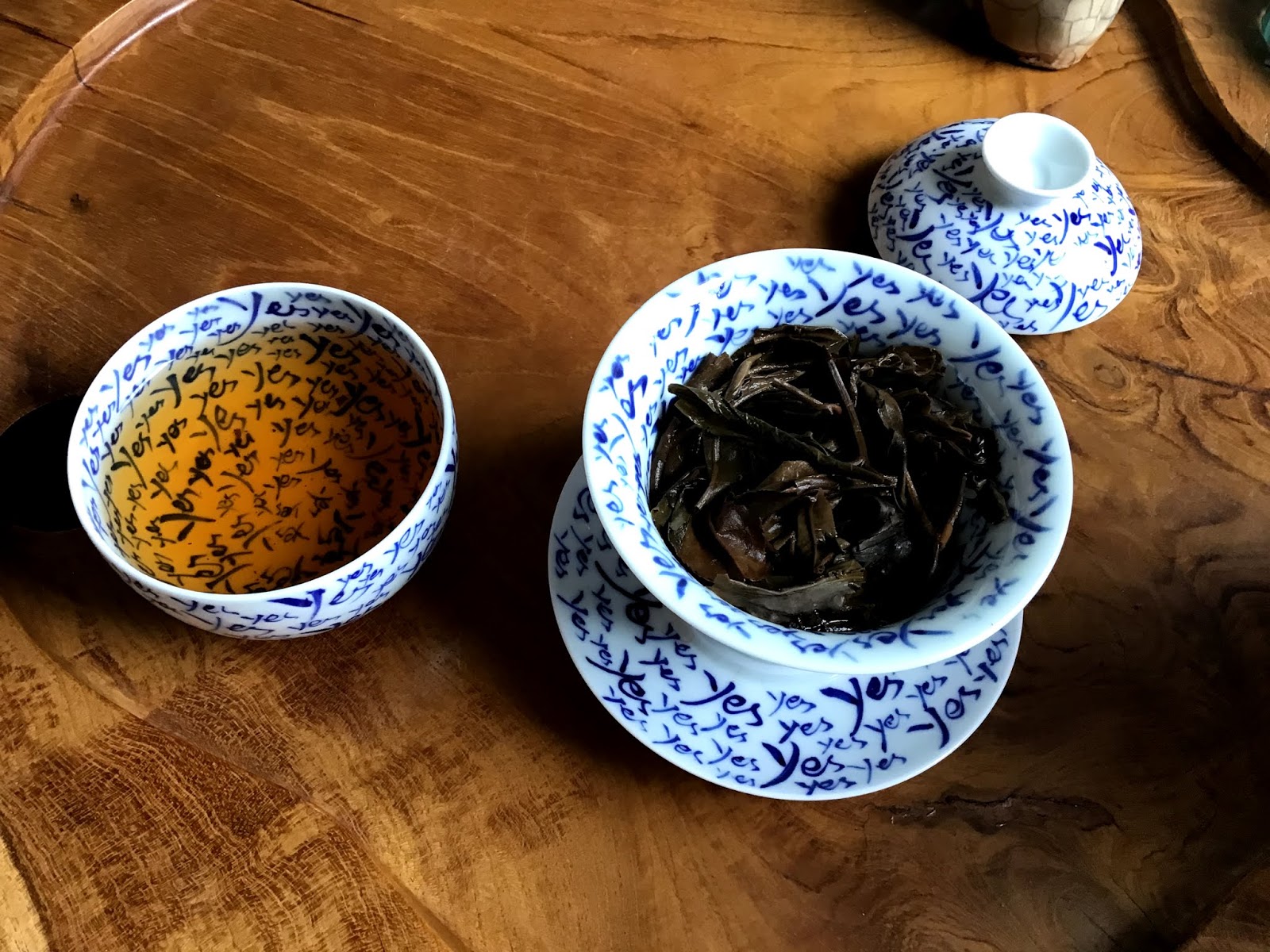
Leaves are nice and big, the sample I got from the cake (an expensive one, being $326 for 400g from my source) looks losely compressed. The tea itself reminds me of the better Yiwu productions of San Ho Tang which started to age slowly. It is not aged yet, but it's already past the very fresh phase. 

Excellent taste, great throat feel. 

This is the first sample from the sample set and yet this is my favourite one from the set (ok, this may change as I will try more of the teas).


03 July 2018

2018 Essence of Tea Wuliang Forest Garden

This is one of the cheaper beengs from EoT 2018 preorder cakes. Unfortunately, it's already sold out.


The cake is double wrapped, with inner wrapper from handmade paper with a blue cloth sewn into it (a style typical for EoT since last year) and a name of the cake sewn under the cloth. The second, inner wrapping paper is clean white, not hand made.


Cake itself looks really good, nice big leaves, good compression, not too tight but neither too loose, you need a pick to pry some leaves from it. I'm drinking this beeng for about a week now, so part of the cake is already missing.


The tea itself is nice, without any smoke - when taking these photos I forgot my tea in the pot and it brew for 20 minutes instead of 20 seconds, and it was really really strong, yet when I tried it I felt no off or unpleasant flavors. For the regular brews the energy of the tea is good, aftertaste is decent and I did not felt any taste that would make me think that the tea will age badly.


I was able to squeze maybe 12-14 good infusions (using 8 grams for 150 ml pot) before the tea went in a direction I did not like. Most of the time I gave up before the tea, with one exception when I overbrew the second infusion, yet still I was able to make a few decent infusions after that.


This is the first tea I tried in 2018, yet comparing it to other teas from the past this one have a promise to be good or even great. Yet it's drinkable right now. 

26 April 2010

2009 Xi-Zhi Hao Shu minibeeng

This is the second minibeeng from the Xi-Zhi Hao pu-erh tea gift set sold by Hou De. As Hou De stated, it's made from tiny pieces of mao-cha that left after sieving the spring 2009 Xi-Zhi Hao mao cha used for sheng cakes. These leftovers were then fermented by an ex-Meng Hai Factory master.

2009 Xi-Zhi Hao Shu minibeeng

The beeng looks and smells good, the smell reminded me of 2005 Menghai Golden Needle White Lotus I have. Not a bad start. The tea brews very dark yet clear soup with no fishy or pondy taste or smell. I drink shu pu-erh only once in a while, because I know, how it's made, but this tea is fine by me - it's gentle and smooth.

2009 Xi-Zhi Hao Shu minibeeng
What is hidden in the dark depths of this tea?


Now, the negative side of this tea. As you can see on these bottom picture, the tea leaves are extremely fragmented, it's almost a tea dust, so you cannot expect too many good infusions made of this beeng. Even when I broke a whole chunk, it fell apart in seconds, making a coffee-colored liquid and in fourth brew it sharply started to fade into nothingness.

This pu-erh requires either very short infusions with moderate amount of tea leaves, making it into sixth or seventh infusion gracefully, or slightly less leaves with longer infusion times - but then you can expect only two or three good brews. Even prolonging the infusions at the end does not help, the tiny bits of tea already totally gave up.

2009 Xi-Zhi Hao Shu minibeeng

So my resume is: this xiao beeng, like it's sheng counterpart, is good for softcore tea-drinkers (is this an accurate opposite of hardcore tea-drinker?), being easy and smooth without unpleasant taste. For more experienced tea-drinker this pu-erh may be a bit light and short-living.

To be continued... with the two minibeengs as a whole gift set.

25 April 2010

2009 Xi-Zhi Hao Jing Gu minibeeng

A good sheng beeng, at last!

Or, according to the small size - a good sheng sample, at last! (© by Hobbes)

This is one of the two xiao (mini) beengs from the Xi Zhi Hao gift set sold by Hou De. According to the description, this is from Jing Gu area, same, as the 2007 Pu Zheng beeng. Unlike MarshalNs experience with Jing Gu teas, the Pu Zheng is one of my favorites. Expensive, yet very solid pu-erh.

2009 Xi-Zhi Hao Jing Gu minibeeng

I really like this pygmy beeng. The mao cha it's made from is said to be from 2100m high ancient plantations near the Daoist temple "Da Shi Si". I believe this claim - the leaves are whole, big and strong. This is the fourth year tea trees are harvested in this area and they still possess some kick and character.

As I see it, Mr. Chen made this tea as a "gift tea", designed with less orthodox tea drinkers in mind, so we can expect a pleasant experience, not an overpowering one. No smokiness, slight bitterness, good acidity, thick soup with peach notes. On the other hand, the tea isn't powerless or bland and has nice and clean aftertaste.

I believe this is one of the better teas Xi Zhi Hao made after the first productions in 2005. And here is a proof of my appeal for this tiny and young sheng - I'm used not to drink the same tea more than once a week, and yet there's the same beeng after ten days.

2009 Xi-Zhi Hao Jing Gu minibeeng

To be continued... with the shu xiao beeng from the same set. And then, my thoughts on the whole gift set.

13 April 2010

Inner change

Today I (finally!) got my parcel with Xi Zhi Hao samples from Guang. The long waiting is over. I haven't tried the teas by now, but I immediately noticed a slight change - the Xi Zhi Hao changed its logo.

As Guang wrote, the original Xi (Double Happiness) character contained a drawing of an 18th century educational poster. As I heard, that made harder to sell Xi Zhi Hao pu-erh in conservative China. So, the Xi Zhi Hao went the easy way and changed its logo.

Xi Zhi Hao old logo
Here is the original Xi (adult content).


Xi Zhi Hao new logo
And here is the new, safer Xi.


Even the paper changed from hand-made to mass produced shiny white. Well, I liked the old style of Xi Zhi Hao more.

01 February 2010

Light Roast Da Hong Pao

Most tea lovers in my area become addicted in the same way. They were introduced to tea other than tea bags in tea-houses or by friends. Most of us started with simpler and cheaper teas and only gradually learned how to enjoy expensive high quality specialties.

Light Roast Da Hong Pao

But in search of great tea the tea lover should never underestimate the cheap ones. Happens, not often, but nonetheless, that even among them we can find real treasures. One of them is this light roasted Da Hong Pao, sold by Yunnan Sourcing. When I first tasted it, I immediately realized that I discovered something special. Fortunately for me, I already got half pound of this Wu Yi Rock tea.

Of course, you can’t expect a masterpiece, "just" a really good everyday tea. Yet, in this category, it’s among the best that I drank over last two or three years.

Light Roast Da Hong Pao

Leaves are uniform, whole (the post office workers handled this parcel with less aggressively than they usually do) and they carry pleasant fruity-floral aroma. Actually, fruits and flowers can be found in all characteristics of this oolong, giving it balanced, fresh and energetic taste with pleasant mild bitterness.

Actually, mostly due the very light roast, the taste of the tea differs from the usual Da Hong Pao taste quite a lot, being much closer to the taste of Dan Cong teas. This Dan Congish taste is totally unexpected, especially given the price.

Light Roast Da Hong Pao

Durability of leaves is reasonable, giving 5-7 good brews in gaiwan or yixing teapot, and only then are the last bitter and fruity flavors lost and the tea transforms to a sweet and refreshing juice.

I apologize for slightly propagandistic nature of this article, but I am really excited about this tea and I wanted to share my feelings.

22 January 2010

Gamma - "Bulang Shang Yun"

After quite a some time I'm finishing the five samples Hobbes sent out to us in the Yunnan Sourcing tasting event. This is Bulang tea made of semi-aged 2006 autumn maocha harvested in Man Nong village near Ban Zhang. The leaves should be harvested from wild arbor trees.

Bulang Shang Yun

The beeng looks nice, with medium-light compressions – it separates easily into leaves. The leaves are definitely darkest of all five samples without any detectable smell. The pictures are somewhat darker because of my dark tea tray, but they show off the leaf and liquors real color quite well.

Bulang Shang Yun

The liquor is orange, maybe a bit too orange for its age. This certainly isn’t a very complex tea; the taste is clean with some aftertaste. I was surprised, how short living is this pu-erh – it turned into sweet juice by sixth infusion. Also, I disliked the mushroomy taste in late infusion – I hate the smell of mushrooms.

Bulang Shang Yun

I’m not fan of this tea. It’s short living, lacking the so needed kick and real character, just a shade of best Bulang teas. I judged it as last of the first three samples.

The samples so far, from best to not so best:
1. Alpha - Yi Wu
2. Beta - You Le
3. Gamma - Bulang

Other reviews - Tea Goober, MattCha's blog, My Private Tea Collection and The Half-Dipper.

08 January 2010

Korean Tea Jelly

One of my favorite blogs is Mattcha’s Blog. I love his photos of Korean pottery – cups, pots and other teaware. Also, his description of Korean teas makes me drool like a Frankensteins monster. Unfortunately, genuine Korean tea is very hard to get, with probably none online sites where one can get few grams of these delicate tea specialties.

So I was very happy, when I discovered, that not far from us there is a grocery store with genuine Korean cuisine – the shop opened for Korean management of automobile factory that opened in Slovakia few years ago. So I made a visit to sea, if they have some decent tea.

Unfortunately, I found only few teabags, one Japanese sencha and a bottle of jelly labeled Honey citron tea.

Korean Tea Jelly

Ok, I couldn’t resist a tea jelly, so I got a bottle and decided to try it on my colleagues. The preparation was easy – just dissolve a spoon or two of orange gelatinous mass in hot water and let your boss to drink it.

Korean Tea Jelly

Since the colleagues (both) survived the experiment, I had a cup for myself. Actually, the beverage itself isn’t as bad as it could be – a very sweet citron-like slightly orange “tea”. I can finish the whole bottle in my work, though I will probably not get another one (I will certainly not get another one).

Korean Tea Jelly

Yet, the hunt for Korean tea still continues.

08 November 2009

Oolong speculations

A very disturbing article about speculation with prices of Taiwan oolong teas can be found at TC Formosa Tea. I hope this will not become a regular activity next years and we will be able to acquire a good quality lishan tea in next years.

25 September 2009

Beta - "You Le Zhi Chun"

This is the second sample of tasting of pu-erh teas made by Yunnan Sourcing. First was one of the most expensive teas made from high altitude Yi Wu mao cha, this tea is made from spring 2009 mao cha harvested in Long Pa village of You Le Mountain. The beeng is on a looser side with nice whole leaves. The fresh scent is less powerful, than the smell of the Yi Wu sample.

You Le Zhi Chun

I liked this tea less then the Alpha. The overall craftsmanship is good, the tea produces clear yellow soup with just a little smokiness, lasts quite long and has some kick. Yet, it’s more crude then the first sample, with much less sweetness, fruitiness or vegetal tones.

The leaves are mostly small, though some large can be found in the mix. The black dots tell us, that pesticides were probably not used this year, and that’s good. Some of them are much darker and shows signs of bad processing with too late kill-green step. Fortunately, these dark leaves are only a few.

You Le Zhi Chun

This is an OK tea compared to the whole selection of pu-erh offered by Yunnan Sourcing, yet from these five samples this is definitely not the tea of my choice.

The samples so far, from best to not so best:
1. Alpha - Yi Wu
2. Beta - You Le

Other reviews can be found on Half-Dipper.

23 September 2009

Alpha - "Yi Wu Gua Feng Zhai"

This is the first of the series of cakes produced by Scott at Yunnan Sourcing LLC. The tea leaves were picked at "Gua Feng Zhai" (The Stockaded Village of Howling Wind) - according to descriptions, one of the remotest and highest regions of Yi Wu. Leaves from the same area were used by Chen Guang He Tang in his 2006 and 2007 Yi Wu beengs.

Yi Wu Gua Feng Zhai

This tea is very fresh. After opening the sample bag I immediately felt the aroma of tea leaves – fruity, slightly grassy. I’m certain this tea will change considerably within next year – it will loose this young feeling and will turn into something different. The tea leaves were quite nice and at least some of them had the wild feeling.

The tea was yellow, clear without any detectable smokiness nor astringency. A very good drink-me-now pu-erh with some kick. For me, it’s more on the drink-now side then the age-me side. And since I have way too much beengs opened for drinking right now, I will not buy a beeng of this. By my opinion, this tea is decent, but lacks the true strength and character to be it exceptional.

Yi Wu Gua Feng Zhai

While this tea was good, it certainly wasn’t the best – at least its cha qi did not make me jump, like one of the other samples. While Hobbes liked this one the most, my favorite will be reviewed later.

16 September 2009

2009 Wen Shan Fo Shou

I had the Fo Shou (Buddha hand) oolong harvested in summer 2009 in Wen Shan area of Taiwan. I got this tea from a local vendor, Longfeng, who delivered me lots of great teas before. This particular oolong is hand harvested and home roasted.

2009 Wen Shan Fo Shou

The leaves are small and even with light fruity smell. I prepared this tea “Czech tea-house style” – it is actually a gong-fu preparation in a yixing teapot, though gaiwan is more often used - mostly because good gaiwan is cheaper than a good yixing teapot. There is one specific though - the water used during preparation is kept hot in a glass pitcher with a tea candle lit under it. Because of this, the water isn’t boiling, so you have to use longer steeping times and more leaves.

This style of tea making has two major benefits – one do not have to care reheating the water and also there is no danger of burning the tea leaves.

2009 Wen Shan Fo Shou

This is a quite good oolong – lasted for 8 good infusions, with clear soup and very fresh and fruity aroma. The roasted taste was nearly undetectable. I liked this one a lot.

09 September 2009

2007 Hai Lang Hao Bulang Wild Arbor

This tea sold by Yunnan Sourcing claims to be wild arbor pu-erh made from first flush 2007 spring mao cha harvested in Bulang mountain range from 70-80 years old tea trees. I got a sample of it together with various other Hai Lang Hao samples, and I decided to give it a try, since Hobbes praised it quite high.

2007 Hai Lang Hao Bulang Wild beeng

From the sample I got I decided to use the whole part – as for most of my stone-pressed beeng samples, I got one half in its pressed form and the second half in separate leaves. The tea liquor smelled quite … it’s hard to describe… Bulangish. It was slightly vegetal with very little smokiness.

What kicked me off my feet was the aftertaste of the first few infusions. Strong, clear, everlasting. I believe it is Bulang where Red Bull got the inspiration. Ok, except the taste.

2007 Hai Lang Hao Bulang Wild beeng

Unfortunately, the tea faded quite soon, after the sixth infusion it turned into sweet water. The character found in the first few infusions was completely missing.

The leaves are tiny, so I suppose they could be spring harvest and some of them even look like wild arbor.It is an OK choice, but I think I will look into the other Hai Lang Hao samples for something longer lasting.

02 September 2009

2005 Chen-Guang-He Tang "MengHai Yieh Sheng"

According to information provided by Guang, the Menghai Yieh Sheng (Wild) is a beeng produced by Chen Guang He Tang in 2005 as a blend of Ban Zhan (not Lao Ban Zhang) and other Menghai wild spring leaves harvested at 2005. This is one of the more expensive young pu-erh, a standard 357g beeng costs $120. It must be an exceptional cake to justify that price – so I decided to try a sample and if it’s really that good obtain a whole beeng.

2005 Chen Guang He Tang Menghai Yieh Sheng

This tea is produced by the same producer in the same year as the 1st Tea Expo beeng I like very much and even shares the wrapper design with it. Of course, the price is 4 times as much.

The leaves point out to quite wet storage being much darker and more brownish than the Tea Expo Memorial beeng. The cake looks stone-molded, the sample could be easily separated into single leaves, so I used the most whole and biggest of them for the first time.

2005 Chen Guang He Tang Menghai Yieh Sheng

The smell of liquor points out to the wet storage, though I found a clear fragrance of peaches under the cellar smell. The taste points out to the Taiwanese storing conditions, too, though the aftertaste is excellent, clear and long lasting. Actually, I liked this tea quite a lot, it was energic and fresh with interesting taste.

If this tea is $50 per beeng, I would easily buy few cakes to store and drink later, but since its $120, sadly I have to live without it.

30 August 2009

Ceramic tea tray by Xu De Jia

I use my wooden tea tray since 2003 and it serves me well since then. Unfortunately, because of its size it’s quite unhandy to use on my work desk, and since last winter I had to work quite a nights, I decided to get a smaller, ceramic tea tray.

Celadon Lotus Petal Tea Tray

This is a celadon tea tray made by Taiwanese artist Xu De Jia I acquired from Guang at HouDeAsianArt. The tea tray is made from bluish "Chin Tzi" celadon in stylized form of Lotus With Eight Petals. The tray is quite heavy and feels massive and the tea stand (isle) found in the center of it is removable.

Celadon Lotus Petal Tea Tray

First, let's describe how celadon works. When purchased, it’s clear and translucent without any visible cracking – yet, these cracks are there, they are just hollow and hard to be seen. If you click the top image (it’s the outside wall of tea tray), you can see, that from closer look the cracks are there.

The bottom picture is taken from the surface of tea stand, where the cracks are already filled with tea and clearly visible. These cracks appeared as soon as on my third use of the tea tray, and to my surprise, they are much darker on the upper sides of tea tray, than on the bottom, though the bottom is filled with tea most of the time I use the tray.

Celadon Lotus Petal Tea Tray

The setup of this tea tray is quite easy – the teapot stands on the isle, so I can feed it with tea broth. All unused tea is collected in the bottom of the tea tray. Fortunately, all my pots under 200 ml fits the isle.

Celadon Lotus Petal Tea Tray

But my favorite function of it is the shui fan, container used to store wasted tea and used tea leaves. After my tea session I usually remove the tea isle and clean the pot dumping all tea leaves into the tray.

Celadon Lotus Petal Tea Tray

I have another, more artistic and slightly less comfortable tea tray by Xu De Jia, but I will write about it later…

24 August 2009

White Jade

I spent the last week in Prague, so I took the opportunity and met with Mr. Prachař, owner of Longfeng tea shop. Even though I had extremely little time - it was the last day of our course and my colleagues were very, very eager to go home, I left them and returned an hour and half later with big bag full of teas and tea samples.

Among the teas that I bought there were some Chinese red teas. I haven’t had them for quite a time, so I decided that it's time to drink red tea!

2009 Bai Lin - White Jade

Bai Lin (白琳), literally White Jade is a less known traditional Chinese red tea. This one is the highest grade produced in city of Hu Lin in Fujian province.

The quality of tea leaves speaks for itself – the leaves are long and covered with dense pale hairs, so they resemble miniature dachshund puppies quietly sitting in the cha he. The smell of tea leaves is intense, sweet, reminds me of caramel.

Dachshund puppies
Photo stolen from www.josephpets.com


The quality of tea leaves forces me to prepare it gong fu style. I use one of my oldest yixing teapots made of high quality zi sha. I decided to go for 4 grams of tea per 150 ml of water. I could use more leaves, but I never liked too strong black teas. I keep the infusion times low and use boiling water (fortunately this tea is really made of tea leaves and not miniature dachshund puppies, so boiling water is OK).

2009 Bai Lin - White Jade  - liquor

Liquor has a crystal clear orange-reddish color and makes a strong sweet scent. I know now why I do not drink so often Chinese red tea – it’s just too sweet for my palate, just like Hungarian wine from the Tokaj region. Never mind, let's drink. The taste of tea is sweet caramel mixed with fine fruity flavor; the aftertaste lingers in mouth and reminds me of high quality dark chocolate. I like this one.

27 April 2009

The Leaf issue 5

I just wanted to let you know, that 5th issue of free internet magazine The Leaf is out.

You can read about yixing, tetsubins, Weng Ming Chuan bamboo tea-tools, Ban Zhang pu-erh and more.

04 April 2009

Limited Karigane Gyokuro Super Premium

It’s quite a time I haven’t written anything. Probably a sort of laziness I developed in most recent times. But it caused not only stopped blogging, but also drove me to some easier ways to prepare tea, than gong fu.

But spring is finally here, as you can see from pictures. Yes, it's real sunlight. And as the nature wakes up this time of year, I finally gathered enough will to continue writing about tea.

2009 Karigane Gyuokuro Super Premium Teapot

Last month or two I tried Japanese green teas - I ordered a tokoname kyusu teapot and few teas from Hibiki-An and O-Cha and experimented with preparation. Actually, it’s really easy – you just boil the water, let it cool down, pour the water into teapot, let it infuse and drink.

All I need now is to perfect my skill, learn the right water temperature, amount of leaves, infusion times.

2009 Karigane Gyuokuro Super Premium Leaves

Today I had Karigane Gyokure Super Premium from Hibiki-An. Karigane is made from leftover stems and veins of gyukuro (shaded) leaves. Because the karigane is by-product, it’s cheaper than equally good gyokuro or sencha. Also, karigane is made only from high grade of Japanese green teas, so you get good value for your money.

As seen on dry leaves, the tea consist mostly of soft, short, light green stems and dark green leaves. The smell of these leaves if fresh and vegetal, yet very subtle.

Subtle is good description for this tea. The liquor is very light green in colour, clear, like spring water, the smell reminds me of citrus fruits. The taste is sweet, again the slightly acidic, refreshing taste predominates. Fortunately for me, the fishy, sea smell sometimes found in Japanese tea is absent in this tea.

2009 Karigane Gyuokuro Super Premium Leaves

This tea isn’t really complex and it’s quite easy to ruin it into potato sweetness, but I still like it. Interesting experiment, I have to compare it with other karigane teas I have sampled.
28 January 2009

Bacon, tea, potatoes, euro

Two months after my last blog – not counting the one from Monday – Slovakia lost it’s currency, Slovak Crowns, the Euro has a new set of coins with Slovak symbols and we all try to be used to think on much, much lower scale. What was 1000 Crowns before now is 33 Euro. But we will live with it, somehow.

Huo Shan Huang Ya

But let’s tea! I got 50 grams of this fine tea from local vendor, LongFeng (Dragon- Phoenix) maybe a year ago, just after the online store was opened. It’s a yellow tea harvested on spring of 2007 from Huo Shan, Anhui area, hand harvested and hand processed by most traditional methods.

The true yellow tea is quite scarce and hard to find, so I welcomed these charming little tea leaves. As seen on pictures (click to enlarge), the leaves are mostly buds and two-leaves-and-a-bud, some of them are quite hairy. On used leaves signs of slight fermentation are clearly visible. Durability is OK, I can squeeze 10 infusions from this tea with ease.

Huo Shan Huang Ya

I was worried about the potency of the tea, since I have it for more than a year now, but, fortunately, the tea was the same as I remembered.

I haven’t had a chance to drink yellow teas before, so I’m still puzzled about the taste and smell of this tea. I liked it from the first moment, but I was doubtful if it should taste like this. Because in pu-erh, for example, you can find tones of fruits, tobacco, camphor. In this tea – it’s bacon and baked potatoes. Really!!

Huo Shan Huang Ya

I love this tea, drinking it on cold winter nights. Unfortunately, I have leaves enough only for one last session – but there are other tea adventures ahead.

26 January 2009

What a coincidence!

Even though I haven’t purchased tea for some time, I still check HouDeAsianArt regularly. And few days ago I noticed a new beeng from Chen-Guang-He Tang in stock.

2005 Chen-Guang-He Tang
Source: HouDeAsianArt.com


I knew that wrapper, I see it somewhere before. But it took me some time to realize, that I have a beeng like this in my possession. Good beeng, by the way. I took a picture of this cake to remind you, how it looks like.

2005 Pu-Erh Tea Fair

First beeng is produced by Chang Tai Tea Factory; the other one is made by Chen-Guang-He Tang, both being made in 2005. Could it be a coincidence?

Update: After MarshalNs comment I made some deeper research on connection between these two beengs. When I wrote this blog I believed, that there is no connection, they are separate products of Chang Tai tea Factory and Chen-Guang-He Tang Tea Factory. Later I learned, that the 1st Pu-Erh Trade beeng (bottom one) was produced under supervision of Mr. Chen Zhi Tong, owner of Chen Guang He Tang (top beeng). Still I did not expected him to use the same wrapper design on two such distinctive beengs.